Understanding the Kenya Police C8 Descriptive Form: A Comprehensive Guide
In the Kenyan criminal justice framework, effective law enforcement relies heavily on documentation. Among the various tools utilized by the National Police Service (NPS) and the Directorate of Criminal Investigations (DCI), the Kenya Police C8 Form—officially known as the Descriptive Form—serves as a primary document for recording precise information about an accused, wanted, or suspected individual.
Whether used to profile a fleeing suspect, circulate details across police stations, or assemble prosecution files, understanding the purpose and structure of the C8 form is essential for legal practitioners, officers, and researchers.
What is the Kenya Police C8 Form?
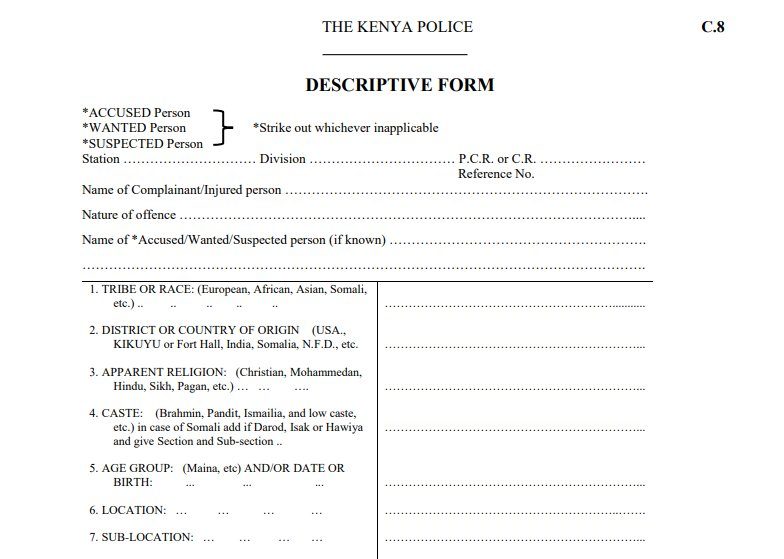
The C8 Form is a standardized descriptive questionnaire containing up to 35 detailed fields designed to create an exhaustive physical, behavioral, and background profile of an individual. Unlike routine administrative forms, the C8 focuses on deep visual markers, personal habits, and social identifiers.
When law enforcement officers need to issue a look-out alert, publish details in the Kenya Gazette, or cross-reference suspect descriptions with fingerprint databases (such as the C20 fingerprint form), the C8 Form acts as the core blueprint.
Key Sections and Fields in the C8 Form
The C8 Form breaks down suspect identification into specific categories:
1. Case & Status Information
At the top, the recording officer links the document to an active investigation by filling in the station name, Occurrence Book (OB) number, name of the injured party/complainant, and the nature of the alleged offense. The individual is categorized as an Accused, Wanted, or Suspected person.
2. Social & Socio-Cultural Identifiers
To narrow down identity in local contexts, the form records socio-demographic details, including:
-
Tribe or Race: (e.g., African, European, Asian).
-
Origin & Residence: District/country of origin, home location, sub-location, and normal place of residence.
-
Religious & Cultural Background: Apparent religion, caste, or age group.
-
Employment History: Present and past known occupations or primary trade.
3. Detailed Physical Anatomical Breakdown
The core strength of the C8 form lies in its physical breakdown:
-
Structure & Tone: Height, build (stout, medium, thin, stooped), and facial shape (long, round, broad, scowling).
-
Complexion: Skin tone categorized specifically (light, dark, sallow, pale, albino).
-
Facial Features: Detailed descriptors for the forehead, eyebrows, eye peculiarities (e.g., squint, glasses, blind), nose shape (flat, hook, broken), mouth, lips (protruding, cracked), teeth (gaps, discolored, filed), chin, and ears.
-
Hair Details: Color, thickness, style, hairline, and facial hair growth.
4. Distinguishing Marks and Peculiarities
Physical attributes that cannot easily be disguised receive heavy emphasis:
-
Marks: Scars, birthmarks, warts, tattoos (location and design), and tribal markings.
-
Behavioral Traits: Peculiarities such as walking style (gait), limb deformities, speech patterns, accents, stammering, or distinct habits.
Best Practices for Filling the Form
-
Use Block Letters: Fill out all sections in clear, black or dark blue ink to ensure scannability and legibility across police divisions.
-
Maintain Objectivity: Describe physical characteristics factually using standardized terminology rather than vague personal observations.
-
Document Specifics: When recording scars or tattoos, always note the precise body location, size, and appearance (e.g., "2-inch vertical scar above right eyebrow").
The Kenya Police C8 Form remains a foundational tool in forensic identification and intelligence-led policing, bridging field investigations with courtroom prosecution.